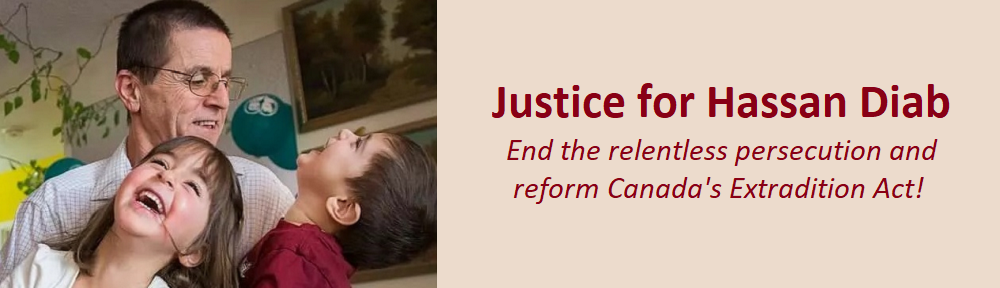
Canadian “K”: Hassan Diab’s Kafkaesque Twilight

“Despite Incredibly ‘Weak Case’, Hassan Diab Forced to Keep Resisting Extradition to France”, by Matthew Behrens

Dr. Hassan Diab is a Canadian university professor fighting for his freedom, and for his life.

The French government wants him to face trial for what they allege is Dr. Diab’s involvement in a 1980 bombing that killed four people. If convicted, he could spend the rest of his life in prison.

There’s a small problem: Dr. Diab’s fingerprints don’t match the suspect’s. His palm prints do not match. The physical description does not match. The handwriting does not match. Allegations against him have been found “weak”, “suspect,” and “confusing” by a Canadian judge; that same judge concluded June 6 that “the case presented by the Republic of France against Mr. Diab is a weak case; the prospects of conviction in the context of a fair trial, seem unlikely.”

With such a strong defence, one would think Dr. Diab would be breathing easy. Instead, he is strapped to a GPS monitoring bracelet for which he must pay $2,000 a month (a new version of the Dickensian debtors’ prison, in which your freedom is now dependent on your ability to pay the state’s surveillance costs), barred from leaving his home without a court-approved monitor, and faced with a curfew worse than that imposed on most 10-year-olds. He cannot teach, his home is frequently invaded by RCMP agents, and he lives with the unimaginable stress that he might spend the rest of his life in a small French jail cell…

Read the full article at:

http://www.pacificfreepress.com/news/1/9223-canadian-qkq-hassan-diabs-kafkaesque-twilight.html

Prism TV: The Case of Hassan Diab

On June 19, 2011, Prism TV’s “Rights and Security” discussed the case of Hassan Diab.

Host: Yahya Abdul Rahman, community activist

Guests:

  • Rania Tfaily, Hassan’s partner
  • Matthew Berhens, human rights campaigner
  • Gary Botting, Vancouver-based lawyer and expert in extradition law and wrongful conviction

Recorded video:

Canada’s Unfair Extradition Law

Hassan Diab’s case highlights the injustice of Canada’s Extradition Law and should be of concern to everyone. The issue has been widely covered in the media, including the following:

Released on Bail

On Tuesday June 14, 2011, Hassan was released on bail after spending more than a week in detention following the judge’s decision to commit him to extradition.

Hassan’s very strict bail conditions include GPS monitoring (for which Hassan has to pay $2,000 per month), a curfew, and over a dozen sureties.

Sincere thanks to Hassan’s supporters for signing a petition asking that Hassan be free on bail while he is appealing his extradition order.

Court Decision

On June 6, 2011, the judge in Hassan Diab’s extradition case announced his decision to commit Hassan for extradition to France. Hassan was immediately taken to a detention centre in Ottawa.

“In his decision, the judge described the Record of the Case (ROC) provided by France as “replete with seemingly disconnected information”. The judge also noted that the ROC “contained a great deal of argument, hypothesis, conjecture, and references to information received, without describing the source of that information or the circumstances upon which it was received”.

The judge made clear that without the French handwriting analysis report, he could not have committed Hassan for extradition. This is the same handwriting report that that the judge found to be “very problematic”, “very confusing”, and with “suspect conclusions”, and described it as “susceptible to criticism and impeachment”.

In his conclusion, the judge wrote that France presented “a weak case” and that “the prospects of conviction in the context of a fair trial, seem unlikely. However it matters not that I hold this view”. The judge said he must commit because he is bound by Canada’s extradition treaty with France.