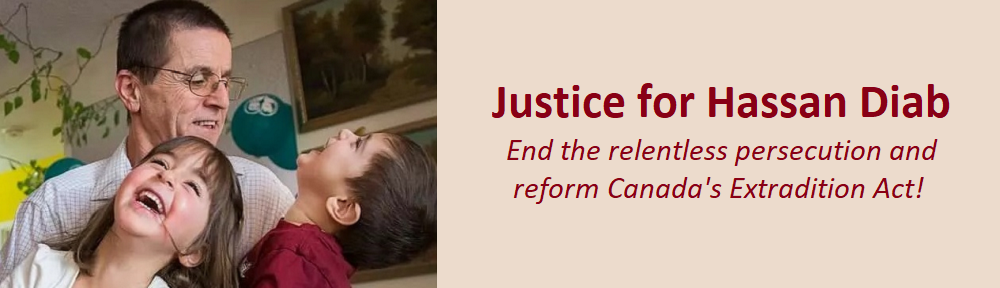
“Despite Incredibly ‘Weak Case’, Hassan Diab Forced to Keep Resisting Extradition to France”, by Matthew Behrens
Dr. Hassan Diab is a Canadian university professor fighting for his freedom, and for his life.
The French government wants him to face trial for what they allege is Dr. Diab’s involvement in a 1980 bombing that killed four people. If convicted, he could spend the rest of his life in prison.
There’s a small problem: Dr. Diab’s fingerprints don’t match the suspect’s. His palm prints do not match. The physical description does not match. The handwriting does not match. Allegations against him have been found “weak”, “suspect,” and “confusing” by a Canadian judge; that same judge concluded June 6 that “the case presented by the Republic of France against Mr. Diab is a weak case; the prospects of conviction in the context of a fair trial, seem unlikely.”
With such a strong defence, one would think Dr. Diab would be breathing easy. Instead, he is strapped to a GPS monitoring bracelet for which he must pay $2,000 a month (a new version of the Dickensian debtors’ prison, in which your freedom is now dependent on your ability to pay the state’s surveillance costs), barred from leaving his home without a court-approved monitor, and faced with a curfew worse than that imposed on most 10-year-olds. He cannot teach, his home is frequently invaded by RCMP agents, and he lives with the unimaginable stress that he might spend the rest of his life in a small French jail cell…
Read the full article at:
http://www.pacificfreepress.com/news/1/9223-canadian-qkq-hassan-diabs-kafkaesque-twilight.html