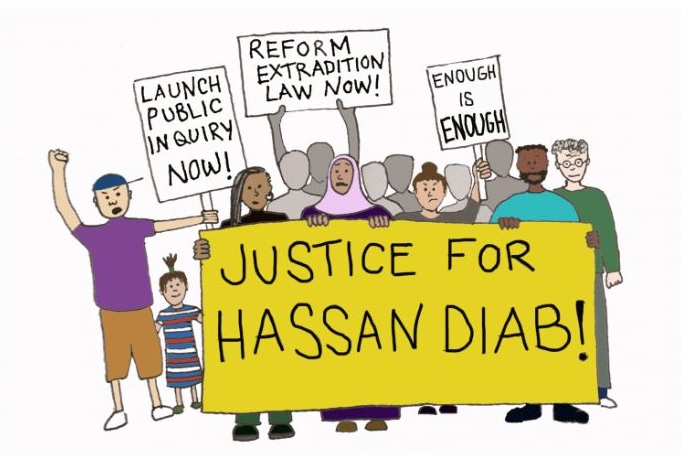
Justice for Hassan Diab Webcomic and Action
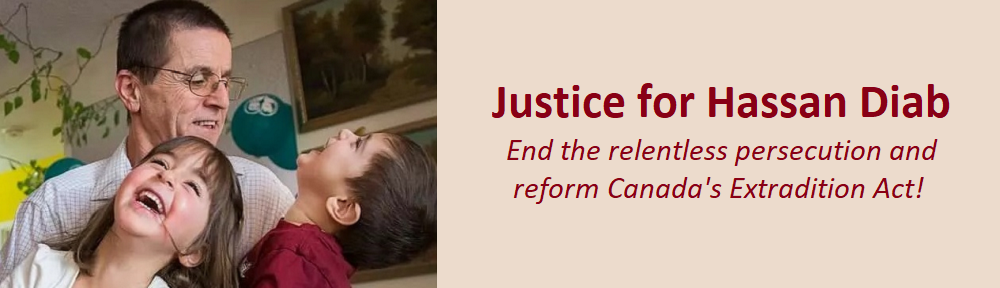
Dear Friends and Supporters,
Canada’s Extradition Act is in urgent need of reform. A recent “external review” of Dr. Hassan Diab’s extradition commissioned by the Minister of Justice does nothing to prevent future injustices like those suffered by Hassan. But we are not giving up!
1) Please write to Prime Minister Trudeau to demand an independent public inquiry into the extradition case of Hassan, and reform of Canada’s Extradition Act. You can send a message to Mr. Trudeau from the following web page:
Your message can have more impact if you personalise the letter to give it a personal touch.
2) Also, on Thursday November 7 or Friday November 8, please call PM Trudeau’s office at (613) 992-4211, and reiterate your message.
For more information:
Background:
Hassan Diab is thankfully free and back in Canada, but justice hasn’t been served. Hassan deserves answers and we need to change Canada’s broken Extradition Act so no one else suffers as he did!
Hassan was wrongfully extradited to France in 2014, based on illogical, problematic, and confusing evidence. He spent more than three years in prison in France, without charge or trial, often in solitary confinement. In 2018, French investigating judges ordered Hassan’s release after they found there is consistent evidence that he was not in France at the time of the 1980 bombing in Paris.
A recent “external review” of Hassan’s extradition, commissioned by the Minister of Justice, has amounted to a whitewash. It presents only weak recommendations that will do nothing to prevent future wrongful extraditions.
Donald Bayne, Hassan Diab’s lawyer, remarked: “The external review basically says nothing wrong was done by anybody. If Canadian prosecutors and the justice system all got it so right, why then did Hassan languish in solitary confinement over three years, an innocent Canadian in a French jail? The standards we are using are clearly wrong. Anything goes in an extradition, and you can’t defend yourself. This will happen again.”
Please contact PM Trudeau now, so your message will reach Mr. Trudeau just as he is preparing the mandate for the next Minister of Justice. It is expected that the new slate of Ministers will be announced on November 20.
Thank you for your continued support!
Click here for a PDF version of the Webcomic (best viewed or printed in landscape orientation).
“The International Civil Liberties Monitoring Group (ICLMG) is deeply disappointed with the findings of the external review into the extradition and detention without trial in France of Dr. Hassan Diab. The review was commissioned by the Department of Justice and conducted by Murray Segal, the former Deputy Attorney General of Ontario.
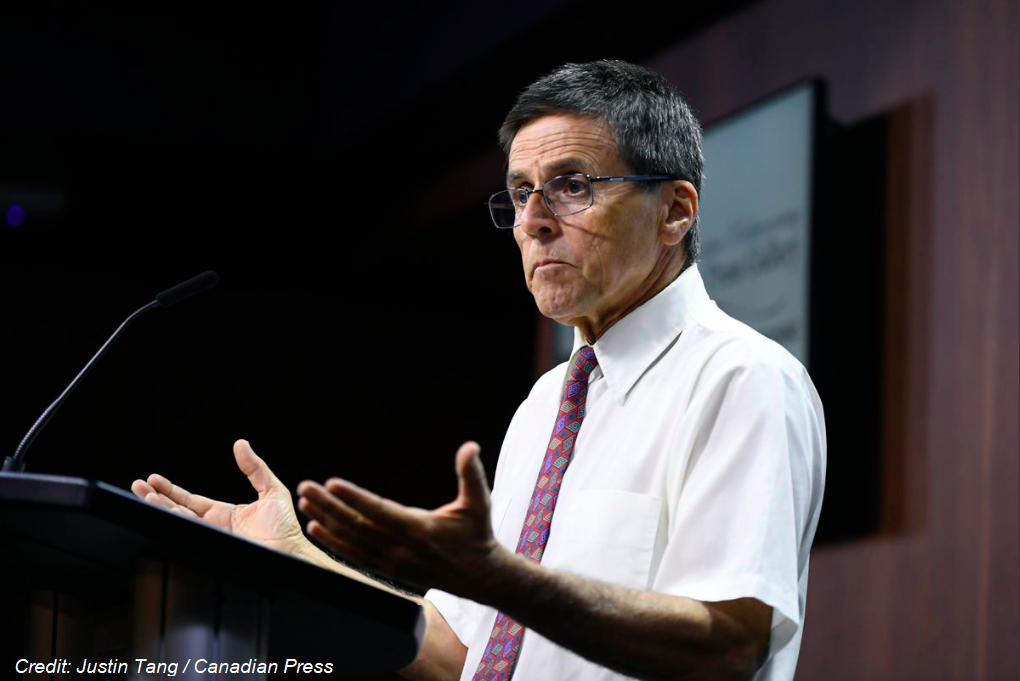 ‘This review, in finding that Department of Justice lawyers and Canadian officials broke no rules, does nothing to bring justice to the grave human rights abuses suffered by Dr. Diab, or to ensure that no other person suffers similar injustices due to Canada’s flawed extradition laws,’ said Tim McSorley, national coordinator of the ICLMG.
Mr. Segal’s report makes various recommendations for the government to take into consideration, but falls far short of suggesting concrete, legislative changes that are needed to truly resolve these issues. This further reinforces the call from Dr. Diab, his supporters, and various human rights and civil liberty organizations, that the government of Canada must initiate a full, public and independent inquiry into the case of Dr. Diab and Canada’s extradition laws. These groups include Amnesty International Canada, the BC Civil Liberties Association, the Criminal Lawyers’ Association, and the Canadian Association of University Teachers, all of whom have issued calls for an inquiry since Dr. Diab’s return to Canada in January 2018…”
Read ICLMG’s full response to the release of the Segal report.
On Friday July 26, after a two-month delay, the Department of Justice Canada released the report of Murray Segal, former Deputy Attorney General of Ontario, who was tasked with reviewing the wrongful extradition of Hassan Diab to France. Mr. Segal concluded that government lawyers acted ethically and followed proper procedures in extraditing Hassan. Mr. Segal reached this conclusion despite the fact that government lawyers withheld exculpatory evidence, were not truthful with the court, and intervened to direct French authorities on how to patch up the case to ensure Hassan’s extradition.
At a press conference in Ottawa after the report was released, Hassan stated: “To say that the Segal report is a disappointment is a gross understatement. It is a one-sided report. Its purpose is not to provide transparency or accountability or to prevent future miscarriages of justice. Rather, its purpose is to absolve the Department of Justice from any accountability and to shield senior officials at the Department from further scrutiny. From the outset, we asked for an independent and transparent public inquiry into my wrongful extradition… I trusted the government’s promise that what happened to me should never happen to anyone else. However, the report promises a continuation of the old way where every Canadian is at risk.”
* * * * *
It is urgent that we voice our dissatisfaction with the Segal report and demand an independent and transparent public inquiry into Hassan’s wrongful extradition, as well as serious reform of the extradition law, so no one in Canada would be subjected to the deeply flawed and unfair extradition process.
Please call Justice Minister David Lametti and urge him to launch an independent public inquiry into Hassan’s extradition and reform Canada’s extradition law.
Minister David Lametti’s Office: (613) 992-4621
When you call, please give your name and where you are calling from. You may be talking to an answering machine. You can leave a message to this effect:
“Minister Lametti, I am profoundly disappointed with Murray Segal’s report on the wrongful extradition of Hassan Diab. Due to the limited nature of Mr. Segal’s mandate, there are many questions about Dr. Diab’s extradition that remain unanswered. We need full transparency and accountability to ensure that the injustice that happened to Hassan never happens again. I urge you to launch an independent public inquiry into Dr. Diab’s extradition and to reform Canada’s extradition law.”
You can also write to Mr. Lametti at:
The Honourable David Lametti
Minister of Justice and Attorney General of Canada
284 Wellington Street
Ottawa, Ontario K1A 0H8
Canada
Email: mcu@justice.gc.ca
* * * * *
Donald Bayne, Hassan Diab’s lawyer, reacted to the Segal report saying: “This is basically a report that says nothing wrong was done by anybody. If Canadian prosecutors and the justice system all got it so right, why then did Hassan Diab languish in solitary confinement over three years, an innocent Canadian in a French jail? The standards we are using are clearly wrong. Anything goes in an extradition, and you can’t defend yourself. This will happen again.”
Josh Paterson, Executive Director of the British Columbia Civil Liberties Association, wrote: “If Canada’s horrendous treatment of Dr. Hassan Diab was legal, then Canada’s extradition law is severely broken and must be changed. This [Segal] report makes clear that our extradition laws are deeply unfair… Dr. Diab was shipped off for lengthy imprisonment in a foreign country on a flimsy case, without even having the right to see and to respond to the evidence against him. Canada’s laws must be changed to prevent anything like this from happening again in the future.”
Alex Neve, Secretary General of Amnesty International Canada, remarked: “That this review effectively concludes ‘no problem here’ is the strongest possible reason why this cannot end here and there absolutely must now be a proper judicial inquiry into what happened to Hassan Diab… Nowhere does the [Segal] report ask the absolutely vital, central and obvious two questions in this case (not surprisingly, because the government did not include them in Murray’s Segal’s Terms of Reference): (1) how did those ‘laws, practices and policies’ fail to protect Hassan Diab from years of agonizing human rights violations; and (2) what needs to be strengthened or entirely reformed, urgently, to ensure no one else goes through such a cruel and anguished experience. Those are the questions Hassan Diab, his family and all Canadians deserve and need to have answered.”
For more information:
https://www.facebook.com/CBCPolitics/videos/394612191169058/
Statement by Dr. Hassan Diab at press conference:
“To say that the Segal report is a disappointment is a gross understatement. It is a one-sided report. Its purpose is not to provide transparency or accountability or to prevent future miscarriages of justice. Rather its purpose is to absolve the Department of Justice from any accountability and to shield senior officials at the Department from further scrutiny.
From the outset, we asked for an independent and transparent public inquiry into my wrongful extradition. We boycotted the external review because we believed that it would amount to a whitewash exercise. It is profoundly upsetting to see our concerns and fears materializing.
I endured over five years of draconian bail conditions and more than three years of imprisonment away from my family and home. My reputation was tarnished; my financial savings were wiped out; my physical and mental health deteriorated, and most importantly l missed the birth of my son and more than three years of my children’s lives.
My suffering and that of my family was prolonged due to the conduct of senior officials at the Department of Justice. Yet the report found that no one was responsible for this miscarriage of justice. Neither does the report call for a serious reform of the very problematic extradition law to ensure that Canadians are protected.
I trusted the government’s promise that what happened to me should never happen to anyone else. However, the report promises a continuation of the old way where every Canadian is at risk. It was alarming to see that the report was seeking to strengthen the existing law by recommending educating the public about extradition steps and procedures.
The report represents a total failure of accountability and transparency. We demand a public and transparent judicial inquiry because justice dies in the darkness.”
For more information:
We were informed that the Department of Justice will release on Friday July 26, 2019, the findings of an external review of Dr. Hassan Diab’s extradition to France in 2014.
The external review was conducted by Murray Segal, former Deputy Attorney General of Ontario. Mr. Segal was asked to assess whether Department of Justice officials followed the law and departmental procedures while pursuing France’s request to extradite Hassan.
After the release of Mr. Segal’s report, there will be a press conference on Parliament Hill. Speakers include: Hassan Diab, Don Bayne (Diab’s Canadian lawyer), Justin Mohammed (Human Rights Law and Policy Campaigner at Amnesty International Canada), and Roger Clark (spokesperson for the Hassan Diab Support Committee).
What: Press conference reacting to Murray Segal’s report on Hassan Diab’s extradition case
Where: 135-B Press Conference Room in West Block on Parliament Hill, Ottawa
When: Friday July 26, 2019, 3:00 PM
Background
Dr. Hassan Diab is a Canadian citizen and sociology professor who lives in Ottawa. He was extradited from Canada to France in November 2014, even though the Canadian extradition judge, Robert Maranger, described the evidence presented against Hassan as “very problematic”, “convoluted”, “illogical”, and “suspect”. However, given the low threshold of evidence in Canada’s Extradition Act, the judge felt compelled to order Hassan’s extradition.
Hassan spent more than three years in prison in France while the decades-long investigation in his case was ongoing – this despite the fact that Canada’s Extradition Act only authorizes extradition to stand trial, not to continue an investigation.
In January 2018, the French investigating judges dismissed all charges against Hassan and ordered his release. They stated that there is consistent evidence that Hassan was not in France at the time of the 1980 bombing in Paris that tragically killed four people and injured dozens. They also notably underlined the numerous contradictions and misstatements contained in the anonymous intelligence, and cast serious doubts about its reliability. The investigating judges also stressed that all fingerprint and palm print analysis excluded Hassan.
Shortly thereafter, Hassan was released from prison in France, and returned to his home and family in Canada. He had spent almost ten years of his life either imprisoned or living under draconian bail conditions, including more than three years in near solitary confinement in a French jail.
In June 2018, CBC News reported that a key fingerprint analysis exonerating Hassan was not disclosed to the court in Canada during the extradition proceedings. The court in Canada was told that no such evidence existed, when in fact the fingerprint analysis that excluded Hassan was done in early 2008, many months before France requested Hassan’s extradition. CBC News also reported that in 2009 a senior lawyer at the Canadian Department of Justice (DOJ) urged the French authorities to obtain new handwriting ‘evidence’ against Hassan when the extradition case was about to collapse. In another effort to shore up the case, the DOJ lawyer requested another fingerprint analysis of a police document signed by the suspect as he believed that the evidence would be very powerful in getting Hassan extradited. When the RCMP fingerprint analysis excluded Hassan, the DOJ lawyer never disclosed this fact to the court in Canada or to the defense.
Numerous human rights, civil society organisations, and labor unions – including Amnesty International Canada, British Columbia Civil Liberties Association, Canadian Association of University Teachers, the Criminal Lawyers’ Association, the International Civil Liberties Monitoring Group (ICLMG), Canadian Union of Public Employees (CUPE), among others – have called on the Canadian government to conduct an independent public inquiry into Hassan’s extradition, as well as to undertake a complete review of the Extradition Act so no other Canadian would go through what Hassan Hassan and his family had to endure.
Hassan Diab Support Committee
diabsupport@gmail.com
“Almost two months have gone by and the [Murray Segal] report is still under wraps. There are concerns that, when it does ultimately appear, it may well be incomplete or heavily redacted.
Extradition is a formal and legally binding process defined in parliamentary acts and treaties between partner nations. It is not a random happening determined by political whim, nor is it a casual matter to be kicked around like a diplomatic football. Yet, when things go wrong, they go horribly wrong and result in dreadful personal consequences for individual and their families.”
Read the full opinion piece:
Dear Friends and Supporters,
It’s been almost two months since Murray Segal submitted to the Minister of Justice his “external review” of Hassan Diab’s wrongful extradition to France in 2014. Up till now, the findings of the review have not been shared with Hassan or anyone outside of government. We are very concerned and disappointed about the extensive delays in making Mr. Segal’s report public.
Please help by phoning Justice Minister David Lametti on Thursday July 18 and Friday July 19, 2019, urging him to release Murray Segal’s report immediately and without redaction, and asking him to launch an independent public inquiry into the role that the Department of Justice played in Hassan Diab’s extradition to France.
When you call, please give your name and where you are calling from. It is likely you will be talking to an answering machine. You can leave a message to this effect:
“Minister Lametti, It has been nearly two months since Murray Segal submitted his report on Hassan Diab’s wrongful extradition to France in 2014. I am disappointed by the lack of transparency and the delay in making the report public. I urge you to make Mr. Segal’s report public as soon as possible, and without redaction. I also urge you to launch an independent public inquiry into Hassan Diab’s extradition and the failings of the Extradition Act. We need full transparency and accountability to ensure that the injustice that happened to Hassan never happens again.”
Please call:
*** Please call every Thursday and Friday, until Mr. Segal’s report is released! ***
For more information:
Thank you for your continued support.
Hassan Diab Support Committee
diabsupport@gmail.com
PRESS RELEASE
For Immediate Release
Hassan Diab and His Supporters Demand Public Release of Segal Report and Renew Call for Public Inquiry and Reform of Canada’s Extradition Act
29 May 2019, Ottawa – Murray Segal, former Deputy Attorney General of Ontario, has delivered a report of his review of the extradition of Dr. Hassan Diab to the Minister of Justice, David Lametti. The Minister’s office has confirmed receipt of the report but has not indicated if – and when – the report will be made public.
Following the dismissal of Diab’s case by French investigating judges and his return to Canada in January 2018, Hassan and numerous human rights organisations have been calling for a full, independent public inquiry to investigate his wrongful extradition to France in 2014. CBC News revealed that Department of Justice (DOJ) officials played a role in advancing Diab’s extradition when the case against him was falling apart, and that exculpatory fingerprint analysis that could have helped clear Diab was never shared by the DOJ with Diab’s defence or with the Canadian extradition judge.
In July 2018, Segal was asked to undertake an external review – instead of a public inquiry – to assess whether DOJ officials followed the law and departmental procedures while pursuing France’s request to extradite Diab.
Remarking on the delivery of Segal’s report, Don Bayne, Hassan’s lawyer, said, “The mandate of Mr. Segal was deliberately too limited – to avoid the hard questions and issues. Mr. Segal’s powers were too circumscribed compared to a judge’s who can compel witnesses and documents. There was no challenge or cross-examination of the DOJ’s version of their conduct. There was no true examination of the dangers and shortcomings of the Extradition Act and procedure (and jurisprudence). We had no access to the behind the scenes letters and documents, thus there was no transparency which this government always championed. Dr. Diab and his family deserve better than this closed door, carefully controlled external review.”
Hassan Diab said: “After suffering a decade under virtual house arrest and near solitary confinement in Canada and France, we need to make sure that wrongful extraditions do not take place again. I urge the Minister of Justice to order a serious, independent, and transparent public inquiry. Anything short of that will only extend the suffering, and miscarriages of justice will continue.”
Tim McSorley, National Coordinator of the International Civil Liberties Monitoring Group (ICLMG) reiterated the call of ICMLG for a public inquiry into Hassan Diab’s extradition and the failings of the Extradition Act. He stated, “The mandate of Mr. Segal’s review was too narrow. The severity of what Dr. Diab has gone through merits the scope and thoroughness of a public inquiry. Only this will ensure a full accounting of the facts, full redress for Dr. Diab, and the information needed to make the necessary reforms so that no Canadian faces the same travesty again. Given the gravity of what Hassan Diab has been through, Mr. Segal’s report should be immediately released. Hassan and the public deserve answers and clarity after his ten-year ordeal.”
Josh Paterson, Executive Director of the BC Civil Liberties Association, stated, “Mr. Segal’s report must be provided to Dr. Diab and his family, and it must be made public without editing or redaction – period. It is also well past time for the government to commit to a full review of the outdated Extradition Act, which allowed this mess to happen in the first place.”
Background:
Dr. Hassan Diab is a Canadian citizen and sociology professor who lives in Ottawa. He was extradited from Canada to France in November 2014, even though the Canadian extradition judge, Robert Maranger, described the evidence presented against Diab as “very problematic”, “convoluted”, “illogical”, and “suspect”. However, given the low threshold of evidence in Canada’s Extradition Act, the judge felt compelled to order Diab’s extradition.
Diab spent more than three years in prison in France while the decades-long investigation in his case was ongoing – this despite the fact that Canada’s Extradition Act only authorizes extradition to stand trial, not to continue an investigation.
In January 2018, the French investigating judges dismissed all charges against Diab and ordered his release. They stated that there is consistent evidence that Diab was not in France at the time of the 1980 bombing in Paris that tragically killed four people and injured dozens. They also notably underlined the numerous contradictions and misstatements contained in the anonymous intelligence, and cast serious doubts about its reliability. The investigating judges also stressed that all fingerprint and palm print analysis excluded Diab.
Shortly thereafter, Diab was released from prison in France, and returned to his home and family in Canada. He had spent almost ten years of his life either imprisoned or living under draconian bail conditions, including more than three years in near solitary confinement in a French jail.
In June 2018, CBC News reported that a key fingerprint analysis exonerating Diab was not disclosed to the court in Canada during the extradition proceedings. The court in Canada was told that no such evidence existed, when in fact the fingerprint analysis that excluded Diab was done in early 2008, many months before France requested Diab’s extradition. CBC News also reported that in 2009 a senior lawyer at the Canadian Department of Justice (DOJ) urged the French authorities to obtain new handwriting ‘evidence’ against Diab when the extradition case was about to collapse. In another effort to shore up the case, the DOJ lawyer requested another fingerprint analysis of a police document signed by the suspect as he believed that the evidence would be very powerful in getting Hassan extradited. When the RCMP fingerprint analysis excluded Diab, the DOJ lawyer never disclosed this fact to the court in Canada or to the defense.
Numerous human rights and civil society organisations – including Amnesty International Canada, British Columbia Civil Liberties Association, Canadian Association of University Teachers, Criminal Lawyers Association, and the International Civil Liberties Monitoring Group (ICLMG) – have called on the Canadian government to conduct an independent public inquiry into Diab’s extradition, as well as to undertake a complete review of the Extradition Act so no other Canadian would go through what Hassan Diab and his family had to endure.
Diab has a lifelong record of opposition to bigotry and discrimination, as attested by family, long-time friends, and colleagues. He has always maintained his innocence and strongly condemned the 1980 crime. He has unequivocally stated, “My life has been turned upside down because of unfounded allegations and suspicions. I am innocent of the accusations against me.”