Independent Jewish Voices Demands Justice for Hassan Diab

Independent Jewish Voices – Canada (IJV Canada) is outraged by the extradition of fellow citizen and human rights advocate, Dr. Hassan Diab, and is demanding for his release from French custody. Dr. Diab has been wrongfully accused of playing a role in the 1980 Paris synagogue bombing.

The evidence levelled against Dr. Diab is “confusing,” “weak,” and “suspect” according to the Canadian extradition judge. His fingerprints do not match those of the suspect, and the evidence brought forth by the French authorities on this matter was even withdrawn, after several internationally-renowned hand-writing experts testified that the handwriting analysis submitted by France is flawed and unreliable.

It is disturbing that Canada has permitted the extradition of a Canadian citizen on very unsuitable grounds, and without providing him with a fair trial under due process of the law. The intelligence evidence being used against Dr. Diab has not been made available to his defence, and it was likely obtained under torture. France does not extradite its own citizens, yet Canada has extradited Dr. Diab without a shred of credible evidence being presented against him.

IJV Canada is very concerned that Dr. Diab will not be granted a fair trial in France. It appears that France’s anti-terrorism laws and use of secret evidence will be used unjustly against Dr. Diab to push for a conviction.

We call on the government of France to abandon its case against Dr. Diab so that he can avoid being the victim of a wrongful conviction. Dr. Diab is being detained in a foreign state on charges for which he has no connection.

Alfred Dreyfus, a French-Jewish citizen, was wrongfully convicted of treason based on faulty evidence. In a climate of anti-Semitism, this blatant injustice was able to take place. Thankfully, strong public opposition within segments of French society pressured the government to re-open the case, which led to the acquittal of Dreyfus on all charges.

It is incumbent upon people and organizations of conscience in France to demand from their government that Dr. Diab be immediately granted his freedom. Much like Dreyfus, Dr. Diab is a victim of faulty evidence, which has led to an enormous injustice against him within today’s climate of anti-Arab and anti-Muslim sentiment.

IJV Canada calls upon the people and civil society organizations of France to join us and our allies in Canada, including Amnesty International Canada, the International Civil Liberties Monitoring Group, and the Canadian Association of University Teachers, to demand from the French government that the case against Dr. Diab be withdrawn, and allow him to return home to his family and friends.

April 2015

For more information contact: Tyler Levitan, Campaigns Coordinator for Independent Jewish Voices – Canada, tyler@ijvcanada.org

A Canadian in Paris: Hassan Diab’s Indefinite Jail Journey

“A Canadian in Paris: Hassan Diab’s Indefinite Jail Journey”
Article by Matthew Behrens in Rabble.ca

“[Hassan] Diab now sits in a cell in the largest prison in Europe for 20 hours a day. This is directly due to the fact that in 2011, Ontario Court judge Robert Maranger upheld the extradition order, despite his conclusion that the case against Diab was ‘weak,’ ‘suspect,’ and ‘confusing,’ concluding ‘the case presented by the Republic of France against Mr. Diab is a weak case; the prospects of conviction in the context of a fair trial, seem unlikely’…

His supporters fear that he will not receive a fair trial in France’s much-criticized anti-terrorism courts. Indeed, Human Rights Watch noted that French ‘decisions to arrest suspects and place them under formal investigation are based on a low standard of proof’…”

Read the full article:
http://rabble.ca/columnists/2015/02/canadian-paris-hassan-diabs-indefinite-jail-journey

False Accusations,
Questionable Forensic Evidence,
Wrongful Conviction

Event : “False Accusations, Questionable Forensic Evidence, Wrongful Conviction”
Date : Saturday, February 7, 2015
Time : 3:00 PM – 5:00 PM
Place : River Building 2200, Carleton University, Ottawa, Ontario, Canada – Map

Guest Speakers :
•   Jamie Nelson (Wrongfully Convicted)
•   Don Bayne (Lawyer Representing Hassan Diab)
•   Peter Gose (Hassan Diab Support Committee)

Sponsored By: Department of Law & Legal Studies Criminalization and Punishment Education Project (CPEP)

ADMISSION IS FREE (Donations are welcome for the Wrongful Convictions and Injustice Association of Carleton)

“We will fight the accusations”

Whisked away from Ottawa before dawn with no chance to say farewell to his pregnant wife and 2-year old daughter, Dr. Hassan Diab remains in detention in the Paris vicinity. A French investigating magistrate placed Dr. Diab under judicial investigation (mis en examen) upon Hassan’s arrival in France. Dr. Diab can expect to be held in detention for nearly 2 years while waiting for the magistrate to conclude his investigation and decide whether or not to put him on trial.

Upon learning of the Canadian Supreme Court’s decision not to hear Hassan’s final appeal, Diab’s lawyer Donald Bayne, said “We now have the classic recipe for the wrongful conviction of a Canadian citizen.”

Hassan_Diab_Rally_20141113

Speaking of the unexpected swiftness with which Canada removed Dr. Diab, supporter Donald Pratt said, “This action by the Canadian government is inhumane to the point of cruel and unusual. This is not about Canada’s authority to do what it has done. This is about failing to respect standards of human decency.”

Hassan was extradited based on a discredited handwriting analysis report that was described by the Canadian extradition judge as “convoluted, very confusing, with conclusions that are suspect.” Extradition legal expert Dr. Gary Botting asked “How can you give any credence to anything that’s one sentence long and hang a guy with it?”

Jacqueline Hodgson, a law professor at the University of Warwick, said: “The case of Hassan Diab, a 60-year-old sociology professor who has been extradited to France, is a troubling one… The evidence against him hinges firstly on unsourced intelligence that would be inadmissible in a criminal court in England and Wales (reliability cannot be tested if the source of information and the manner in which it was obtained are unknown); and secondly on the opinion of a handwriting expert described as wholly unreliable by five of the world’s leading handwriting analysts.”

Hassan Diab is represented by French lawyer Stéphane Bonifassi. Speaking to the Canadian press, Mr. Bonifassi said, “Hassan is in good spirits and I would say in combative spirits. We will fight the accusations, and hopefully the fact that there is no evidence against my client will prevail and he will be set free.”

Hassan Diab Support Committee
diabsupport@gmail.com

Profoundly Disappointing Supreme Court Decision

Today, the Supreme Court of Canada dismissed Dr. Hassan Diab’s application for Leave to Appeal. Hassan, his family, and supporters are disappointed and dismayed by the Supreme Court’s refusal to hear his case, and to address the issues of serious public importance at stake. In response to the Supreme Court’s decision, Dr. Diab issued the following statement.

Français
Statement by Hassan Diab
November 13, 2014

I am deeply shocked that the Supreme Court of Canada refused to even hear the appeal in my case. This is a very sad day for me, my family and supporters, and the state of extradition law in Canada. I had hoped for justice from the Canadian legal system.

I have been living a Kafkaesque nightmare for over six years, fighting false allegations against me, enduring detention, strict bail conditions, the loss of my employment, and enormous stress on my family. It is beyond devastating that the Supreme Court of Canada would allow my extradition for a crime that I did not commit and based on a handwriting analysis report that was shown by world-renowned handwriting experts to be wholly unreliable, totally erroneous, and biased.

It is shocking that this would happen in Canada, despite the numerous commissions on wrongful convictions based on faulty forensic evidence and the Court’s vow to never let this happen again.

I, my family, friends, and supporters, will continue to fight the false allegations that have been imposed on me, a Canadian citizen who is law-abiding, peaceful, compassionate, and who abhors violence.

I am grateful and heartened by the outpouring of support from thousands of individuals and organizations that recognize the injustice that I have experienced and the unfairness of Canada’s extradition law. I am also deeply thankful to my devoted lawyers who tirelessly worked on my behalf for years.

I vow to never give up, and I will always remain hopeful that I will eventually return to my home in Canada and be reunited with my wife and children.

Leave of Appeal Decision to be Released on Thursday November 13

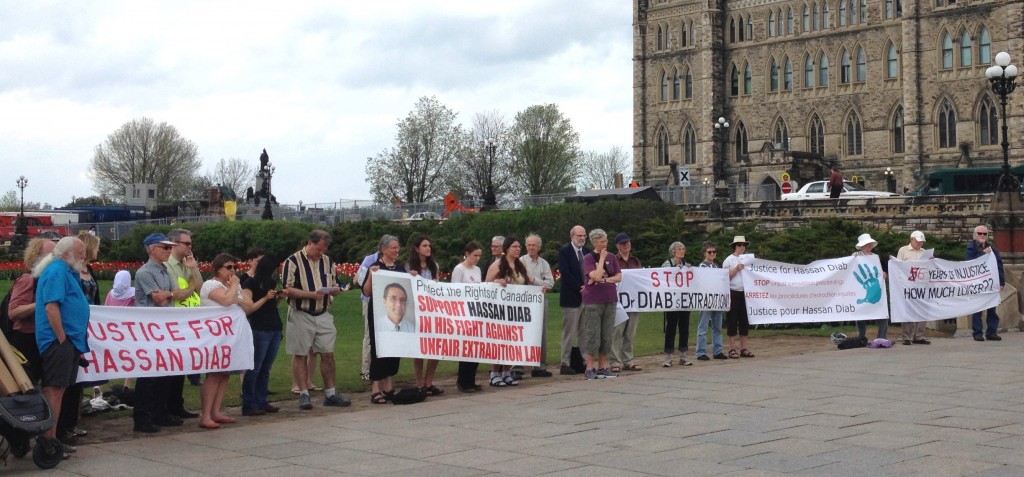
Hassan_Diab_Rally_20140515

Dear Friends and Supporters,

On Thursday, November 13, 2014, the Supreme Court of Canada will announce its decision on whether to grant leave to appeal in the extradition case of Dr. Hassan Diab. We are calling on supporters like you to come out and show your support.

Please join us for a rally at the Supreme Court of Canada on the day of the decision.

What: Rally to support reform of Canada’s extradition law and justice for Hassan
Place: Supreme Court of Canada, 301 Wellington Street, Ottawa — Map
Date: Thursday November 13, 2014
Time: Meet at 9:15 am sharp. We will wait for the decision which is expected to come out at around 9:30 am.

 
The Supreme Court represents Hassan’s last real chance for justice in Canada. If leave is granted, the case would be heard by the Supreme Court sometime in 2015. If leave is not granted, the government would extradite Hassan to France soon after the decision, where he would be incarcerated while the French authorities decide whether or not to put him on trial.

France’s anti-terrorism courts allow convictions based on secret information that is inadmissible in Canadian criminal trials. In Hassan’s case, France is also relying on a handwriting analysis report that has been thoroughly discredited by five leading handwriting experts. A trial conducted in these circumstances offends principles of fundamental justice and condemns an innocent man.

Please bring banners and signs calling for stopping Hassan’s extradition and reforming Canada’s extradition law. We are grateful for the support you have shown Hassan and his family since the beginning, and we look forward to seeing you on Thursday morning.

See: Background information

Hassan Diab Support Committee
diabsupport@gmail.com

Supreme Court Decision on Leave to Appeal Expected Soon

  • The Supreme Court of Canada will soon release its decision on whether to grant leave to appeal in the extradition case of Dr. Hassan Diab. A hearing by the Supreme Court represents Hassan’s last chance in Canada to obtain justice.

    If extradited to France, Hassan would be tried under France’s anti-terrorism laws where secret intelligence from unknown sources is admitted as evidence. In Dr. Diab’s case, no one – not even the French judge – knows where the intelligence came from, the circumstances under which it was obtained, and whether or not it has any reliability. There is a real risk that this intelligence is the product of torture.

    Also alarming is the fact that a discredited handwriting analysis report remains in the dossier in France. The report claims that Dr. Diab’s handwriting resembles five words written by the suspect on a hotel registration card in 1980. Five internationally renowned handwriting experts found that the report is fatally flawed, utterly unreliable, and does not follow recognized methodology; in fact, the experts found that the evidence points to Dr. Diab’s innocence. The extradition judge himself described the report as “very problematic”, “convoluted”, “very confusing”, and “suspect”, but stated that he felt obliged under Ontario’s interpretation of the extradition law to commit Dr. Diab for extradition. It is worthwhile to note that two previous handwriting analysis reports that allegedly linked Dr. Diab to the suspect were withdrawn from the extradition hearing in Canada after Hassan’s lawyers showed that many of the documents that were “matched” to the suspect were not written by Hassan, but rather by someone else. While the French authorities withdrew these two reports from the extradition hearing in Canada, they too remain in the dossier in France.

    Questions of Public Importance Raised by Dr. Diab’s Case

    Hassan’s lawyers urged the Supreme Court of Canada to hear Dr. Diab’s appeal to resolve two constitutional questions of public importance.

    The first question relates to the correct interpretation of Ferras, the leading Supreme Court case on extradition. Appellate courts in Canada are deeply divided on this issue. Dr. Diab’s lawyers argue that Dr. Diab would have been discharged if his case were heard in British Columbia, given that the British Columbia Court of Appeal requires extradition judges to deny extraditions in cases, like Dr. Diab’s, in which the evidence as a whole is so unreliable that it would be unsafe to convict. In contrast, the Ontario Court of Appeal follows a more restrictive test, which limits the task of the extradition judge to examining individual pieces of evidence to determine whether they are “manifestly unreliable”. It does not permit extradition judges to weigh inferences, evaluate the strength of the case put forward, or deny extradition where the judge felt the case to be weak or a conviction unsafe.

    The second question is about protections afforded to Canadians by the Charter. It centers on whether a criminal trial which is based in part on anonymous intelligence that cannot be meaningfully tested ever meets the requirement of a fair process. If extradited to France, Dr. Diab would be tried on the basis of an anonymous intelligence report that no one – not even the French judge – knows where it came from, the circumstances under which it was obtained, and whether it has any reliability.

    Background

    See: Background Information

  • Statement of Support for
    Dr. Hassan Diab by Solidaires Union in France

    “We condemn the wrongful termination of Professor Diab from Carleton University on the basis of an extradition request which neither respects the independence of the University nor the presumption of innocence of a man who has never been convicted of any crime. We condemn the fierceness of the French judicial system based on a weak case against a man who is not allowed to defend himself.

    We strongly condemn that secret information from unidentified sources, that may have been obtained under torture, can be used at court in France.

    We call for the immediate reinstatement of Mr. Diab at the University and the removal of his electronic bracelet.

    We call for an end to this hell inflicted upon Hassan Diab, and the end of the extradition request, as serious and transparent evidence as well as expertise of good quality have not been put forward, and as elements in defense of Mr. Diab have not been considered.

    We must ensure that the real perpetrators of the Rue Copernic crime are brought to justice, but prosecution based on such a weak case cannot lead to the truth.”

    Read the full statement:

    What’s Wrong with Canada’s
    Extradition Law

    Hassan_Diab_Rally_20140515

    Please help us reform Canada’s extradition law!

    Canada’s extradition law is unjust:

    • In extradition, Canadian standards of evidence do not apply. The standard for extradition is so low that Canada hands people over to other countries more or less for the asking, based on the flimsiest of evidence that would not be accepted in a Canadian trial.
    • Evidence submitted by the foreign country is presumed reliable, and the ability of the person sought to challenge the case against him or her is severely curtailed.
    • The foreign country can cherry-pick its evidence and conceal exculpatory evidence. The person sought has no right to disclosure of evidence beyond what the foreign country chooses to place in the Record of the Case.
    • Canada’s extradition law places the burden of proof on the person sought to show that the evidence against him or her is “manifestly unreliable”. The test for unreliability is so high that it is virtually impossible to meet.
    • Canada extradites its citizens to countries that use secret intelligence as evidence, including intelligence obtained from torture.
    • There is a great divide among the provinces across Canada in how they interpret and apply the federal extradition law, and this is contrary to the fundamental principle that all Canadians should be treated equally before the law.
    • Canada’s extradition law is unbalanced. Canada extradites its citizens to countries that do not extradite their own citizens (France, for example).

    In Dr. Diab’s case:

    • The Canadian extradition judge described the evidence against Hassan as “very problematic,” “suspect,” and “weak”. He said that “the prospects of conviction in the context of a fair trial seem unlikely”, but stated that his interpretation of Canada’s extradition law left him no choice but to commit Hassan to extradition.
    • The case was allowed to go forward despite numerous serious contradictions and misrepresentations in the Record of the Case, and despite the reliance on secret intelligence.
    • Evidence showing that Hassan’s finger and palm prints do not match those of the suspect has been suppressed and not allowed in the extradition hearing.
    • Hassan would be a free man if he was living in Vancouver instead of Ottawa, as the province of British Columbia interprets the extradition law differently from Ontario.
    • French authorities revealed that Dr. Diab is not charged, and that he is wanted for investigation purposes only. Despite this revelation, and despite the fact that extradition must be for trial only, the Canadian Minister of Justice signed an order surrendering Hassan for extradition.
    • If extradited, Hassan will be torn from his home and family to languish in jail, possibly for years without trial, while France continues its 33-year investigation.

    If it can happen to Hassan, it can happen to any one of us!

    Despite Setback, Hassan Determined to
    Continue Fight for Justice

    The Court of Appeal for Ontario upheld Dr. Hassan Diab’s extradition. A disappointing decision from the Court for Hassan, as well as for the rights of Canadians. But we will fight on! Hassan’s lawyers are seeking leave to appeal to the Supreme Court of Canada.

    In reaction to the decision, Hassan gave the following statement.